A Company Can Dilute Its Way Through Fear. Bitcoin Can Only Reprice It.

Bitcoin fell below $66,000 on November 14, erasing most of a rally that had carried it to nearly $87,000 two months earlier. In a single day it lost the $70,000 level and then the $67,000 level, with roughly $1.6 billion in leveraged positions wiped out in 24 hours.
The usual questions followed. Is this the top. Is this the bottom. Did something break. None of those questions are wrong to ask, but they skip the one question that actually explains why the chart moves the way it does.
THE QUESTION A FALLING STOCK NEVER HAS TO ANSWER
When a public company's price comes under pressure, it has options a chart alone does not show you. It can issue new shares. It can raise a convertible note. It can dilute existing holders to keep the lights on while the market decides what the business is worth. The supply of the asset itself can move to meet the moment.
That is exactly the trade one value investor flagged while discussing the current drawdown: people selling the hardest money on the planet to buy equity in companies that lose tens of billions of dollars a year, betting those companies will eventually earn their way into the valuation. Whatever you think of that bet, notice what it assumes. It assumes the company's supply of shares, and the capital behind it, can flex to absorb the distance between today's losses and tomorrow's story.
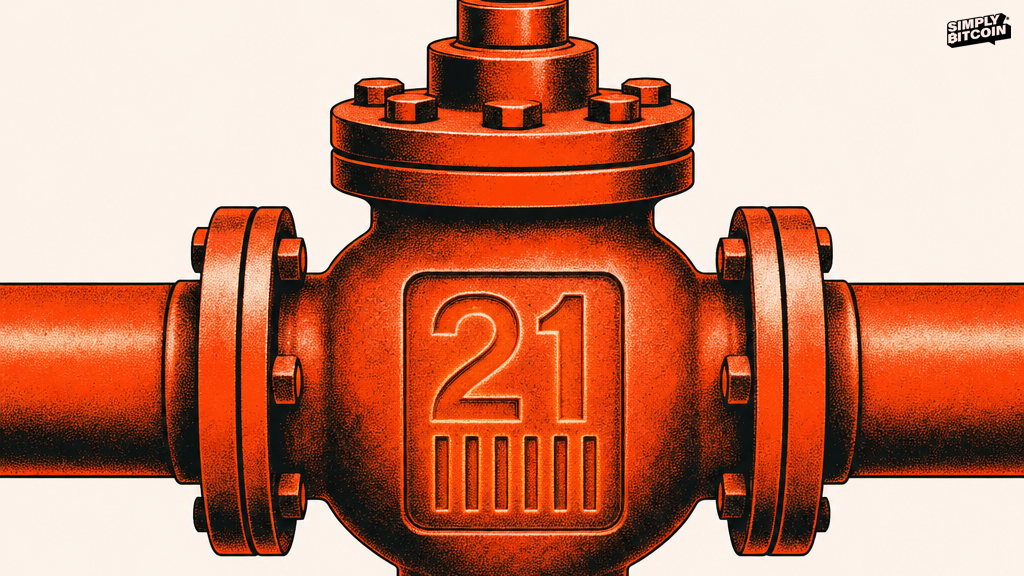
BITCOIN HAS NO VALVE
Bitcoin was not built with that option. There is no board that can vote to issue more of it when sentiment turns. The cap is 21 million, full stop, and the rate new coins enter circulation keeps shrinking by design. One prominent Bitcoin investor has pointed out that Bitcoin's supply is now growing at roughly eight tenths of a percent a year, a slower pace than gold's own mine supply, which typically runs one and a half to two percent annually. Gold, the asset most people already treat as the scarce one, is the more elastic of the two.
That is the entire mechanism. A stock has a supply lever. Gold has a supply lever, slow but real, since a higher price makes more deposits worth mining. Bitcoin has none. When a demand shock hits, every other major asset class has some capacity to adjust how much of itself exists. Bitcoin cannot. The number was fixed before the fear started and it will be the same number after the fear ends.
THE PRICE DOES THE JOB SUPPLY CAN'T
Take away the supply valve and there is exactly one variable left to absorb a shock: price. Every dollar of panic selling, every liquidated leveraged long, every ETF outflow has to clear somewhere, and with issuance frozen, it clears through the chart. A twenty percent move in a month is not Bitcoin behaving erratically. It is Bitcoin doing the only adjustment available to an asset that cannot create more of itself to meet the moment.
This is also why Bitcoin's crashes look so much more violent than the crashes of assets that can dilute, hedge, or print their way through a bad quarter. The violence is not a symptom of weakness in the asset. It is the visible cost of the one property that makes it worth owning in the first place.
THIS HAS HAPPENED BEFORE, ON SCHEDULE
Bitcoin is currently trading near its 200-week moving average, the average of roughly the last four years of weekly closes. Since Bitcoin's 200-week line began, there have really been three bear markets plus the Covid crash where price spent meaningful time below it. Since 2017, only about 10 percent of days have closed below that average, and the one-year return from those closes has historically averaged over 100 percent.
None of that guarantees what happens next, and a small, repeated sample is not a law of physics. But it is consistent with the mechanism, not a coincidence sitting next to it. An asset that cannot inflate its own supply works off excess leverage and excess fear through price, snaps back once the forced selling is exhausted, and does it again the next cycle, because the thing that caused the first snap back, the fixed supply, never went anywhere.
THE TRADE THAT RUNS BACKWARD
Which brings the argument back to the trade worth questioning: selling the one major asset that cannot dilute itself to buy equity in companies that absolutely will, and probably more than once, before their stories resolve. Bitcoin currently sits nearly 35 percent below its all-time high while ETF buyers grow inconsistent and treasury firms slip underwater, and that distance feels like proof the trade worked. But the stock on the other side of that trade has a supply lever Bitcoin does not. Its downside can be diluted away from existing shareholders onto new ones. Bitcoin's downside cannot be handed to anyone. It is paid, in full, by the price, by whoever is holding when the adjustment happens.
That is a real cost. It is also the reason the asset cannot be quietly debased the way almost everything else eventually is.

VOLATILITY IS THE RECEIPT, NOT THE VERDICT
A twenty percent drawdown in a fixed-supply asset is not a verdict on whether it works. It is a receipt showing the mechanism just ran again, because it is the only mechanism this asset has. Every other major asset class gets to spread its bad quarters out through supply. Bitcoin pays all of it, all at once, through the price, every single time, by design.


Daily Bitcoin news, analysis and interviews. New shows every single day.
Subscribe on YouTube