
Trust Minimized Is Not The Same As Trustless

Bitcoiners repeat "don't trust, verify" the way people repeat a password, as if saying it is the same as doing it. This month proved otherwise. A widely used, fully open source Bitcoin hardware wallet was found to have been generating weak keys for roughly five and a half years, in code anyone could have read the entire time.
Nobody hid anything. The function sat in public view. The cipherpunks who bought the device specifically because it was open source never opened the file. That gap between what was possible to check and what actually got checked is the real story, and it says something true about Bitcoin that goes far beyond one company's mistake.
THE SLOGAN EVERYONE REPEATS AND FEW PRACTICE
Open source is treated in Bitcoin circles as a guarantee, a stamp that means the code is safe because it could theoretically be inspected by anyone on earth. That is not what open source means. It means the code is visible. Visibility and verification are different states, and only one of them costs anyone anything.
A ledger left open on a shelf is not the same as a ledger someone actually read line by line. The shelf does not check the math. A person does, and only if that person decides to spend the hours doing it instead of assuming the years of silence already proved something.
OPEN SOURCE MEANS VISIBLE, NOT VERIFIED
This is not a Bitcoin problem. It is a fact about all open source software, and history already ran the experiment at internet scale. OpenSSL is one of the most widely deployed pieces of open source cryptographic software ever written, sitting underneath a large share of the encrypted internet, reviewed constantly by security professionals around the world.
The vulnerability had lurked undetected for two years inside that code before anyone found it. Two years, inside software that millions of engineers had access to and thousands were paid to secure. The eyes were there. Most of them never looked at that specific function.

TRUSTLESS AND TRUST MINIMIZED ARE NOT THE SAME CLAIM
Bitcoin's cryptography is genuinely trustless. A 256 bit private key space is not something you trust to be secure, it is mathematically unbreakable regardless of who is watching, and that has held for seventeen years without exception. Nobody has to take anyone's word for that part.
But the tools that generate, store, and move those keys are written by people and shipped by companies. That layer is trust minimized, not trustless. You are trusting fewer parties than a bank account requires, and you can theoretically check their work yourself, but "theoretically checkable" and "actually checked" are two different claims wearing the same word. The distance between them is exactly where a private key stops being private.
WHAT TRUST MINIMIZED STILL BUYS YOU
None of this makes self custody a wash against the alternative. A bank account routes your trust through a teller, a branch, a compliance department, a deposit insurer, a regulator, and a central bank that can change the value of what you're owed without asking. Each layer is opaque, and none of them are yours to inspect even if you wanted to.
Self custody collapses that chain down to one layer: the software that turned your randomness into a key. One layer is not zero layers, but it is enormously fewer than the alternative, and it is the only version of this where the code sits in public where a person can actually go read it. That is a real advantage. It just is not the same thing as a guarantee.
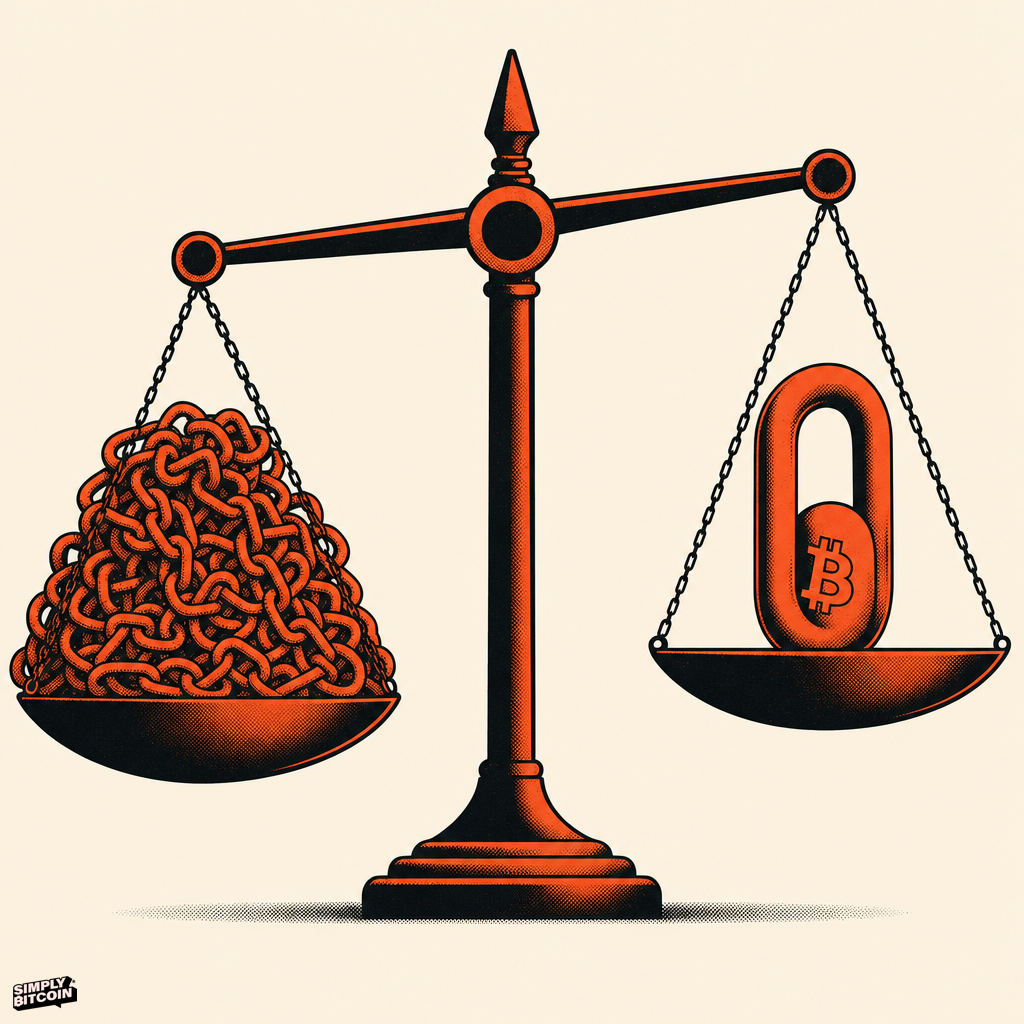
VERIFY IS A VERB, NOT A CERTIFICATE
Buying an open source device does not transfer verification to you automatically, the same way owning a car with the hood unlocked does not mean the engine has been inspected. Verification is something a person has to sit down and do: run your own node, check your own transaction against it, read the entropy source in the wallet you actually use, ask the question you do not know the answer to yet.
Trustless describes what the math already proved. Trust minimized describes everything built on top of that math by human hands, and human hands still need checking. The word "verify" was never meant to be earned once and kept forever. It only means anything for as long as somebody keeps doing it.