
No Vote Ever Decentralized Bitcoin Mining. Bankruptcy Did.
Bitcoin split into two chains this past weekend, and one of them was already falling behind within a day. The argument that caused the split got framed as a fight over spam clogging the blockchain, but the real fight underneath it was much older. It was about who actually controls Bitcoin mining, and the answer turned out to be nobody.
THE RULE THAT NEEDED PERMISSION IT NEVER GOT
The change at the center of the split was a soft fork, the kind of rule that tightens Bitcoin's code without breaking it for everyone still running the old version. A soft fork like that only takes hold if enough mining power agrees to enforce it. In the final stretch before the deadline, roughly two percent of hash power signaled support. The proposal had a backstop written in that let it activate anyway, and for a moment Bitcoin had two competing chains instead of one.
A MINORITY CANNOT BUY WHAT A MAJORITY WON'T GIVE
Whatever you think about either side of that fight, the result answered a bigger question than the one on the ballot. A rule that depends on miner cooperation is never stronger than the miners behind it. Two percent could not force the rest of the network to follow along, and no amount of pressure could talk the rest of the network into signaling for a rule it had not already chosen on its own. Nobody controlled the outcome. Hash power went where it always goes: wherever running a machine stays profitable under the rules that already exist.
No rule has ever redistributed hash power. Cost has.
MINING WAS NEVER DESIGNED TO BE COMFORTABLE
Bitcoin mining has never been a stable industry, and that instability has done more for decentralization than any rule change in its history. Every mining downturn follows the same pattern. Prices fall, margins turn negative, and the operations sitting on expensive power or thin credit disappear first. The ones left standing are the ones that found the cheapest electricity and ran the leanest business, not the ones that signaled loudest in a governance argument. When a major mining region banned the practice outright a few years back, the operations there did not vote their way to a new home. They packed up, chased cheaper power across borders, and the map of Bitcoin mining looked completely different within a year. No proposal did that. Geography and cost did.

WHEN THE BIG MONEY LEAVES, THE SMALL MINER GETS A SEAT
Right now the pressure comes from artificial intelligence pulling data center compute away from mining because the margins are better there. In the last cycle it was something else, and in the next one it will be something else again. The direction of the incentive is what actually matters. Whenever a more profitable use for the same hardware and the same power shows up, some of Bitcoin's largest miners will chase it, and every machine that leaves the network lowers the difficulty for the next smaller miner to clear. A corporate operator walking away from Bitcoin to chase a better contract elsewhere is not a loss for decentralization. It is the mechanism working exactly as designed.
DECENTRALIZATION IS EARNED, NOT LEGISLATED
Code can add a filter, a cap, or a fee. It cannot make a mining pool give up market share, and it cannot make a data center choose Bitcoin over a better contract. Only competition does that. A rule change can decide what is allowed inside a block. It has never once decided who gets to build the block in the first place. That distinction is the whole argument, and it is easy to miss in the middle of a weekend that felt like a civil war.
THE ONLY VOTE THAT ACTUALLY COUNTS
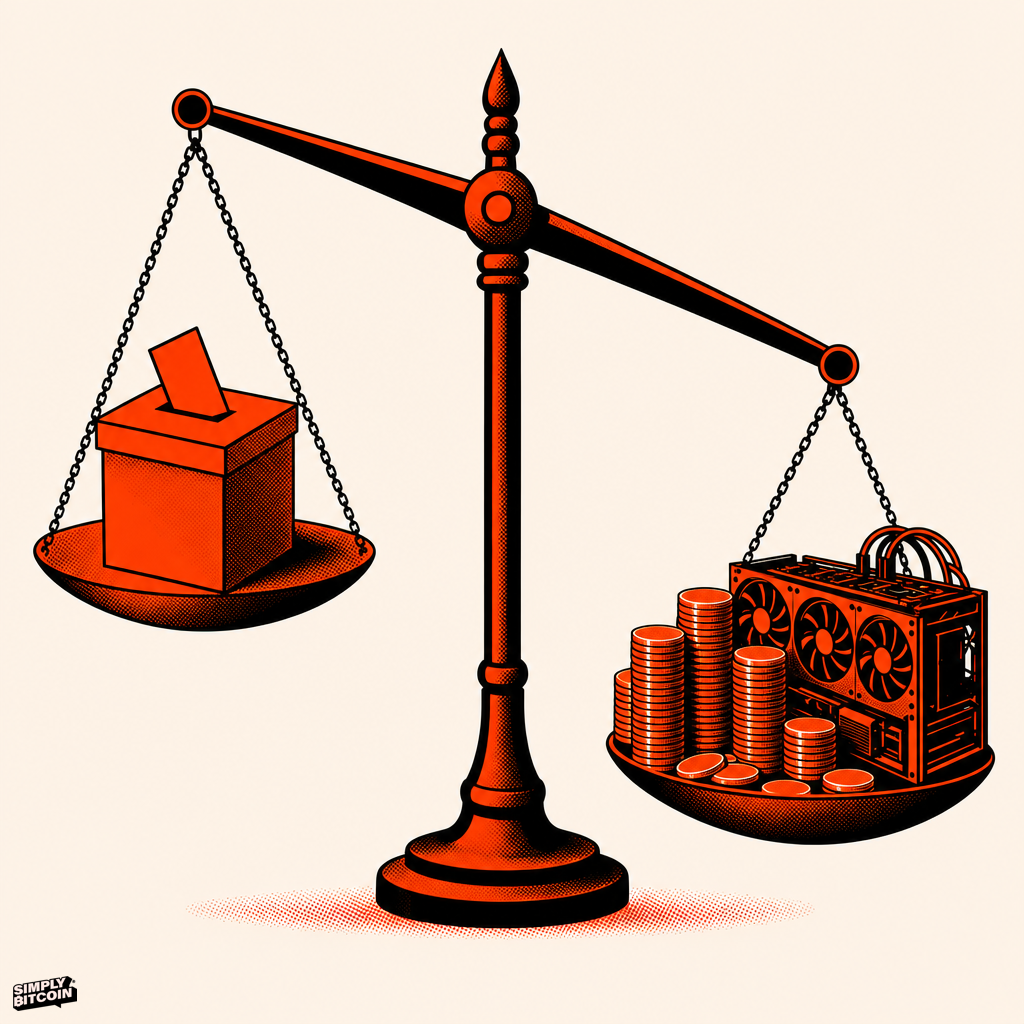
Complaining about mining concentration while never plugging in a machine is not a position. It is a spectator's complaint. Every corporate miner that walks away from Bitcoin for a better margin elsewhere opens room for somebody willing to run a smaller operation at a real cost. That is not a signal bit or a proposal number. It is a machine, drawing power, doing the one thing that has ever actually spread hash rate out.
Bitcoin will keep having weekends like this one, arguments over a rule that a tiny slice of the network gets to accept or reject. Let it happen. The rule was never the thing holding mining together. The cost always was, and the cost is the only vote nobody can rig.