AI Can Make Everything Cheaper. It Cannot Make More Bitcoin.

Every earnings call this year carries the same undertone. A company reports a strong quarter, and the questions that follow aren't about what the business did. They're about whether artificial intelligence is going to do the same job cheaper, next quarter, for someone else. Nobody has a clean answer, and the not knowing is the actual story.
THE COST OF EVERYTHING IS FALLING
AI's whole selling point is that it makes expensive things cheap. Legal advice, software development, financial modeling, translation, design work: all of it gets faster and cheaper the more capable these models become. That's the bull case for AI as a technology, and it's true.
It's also the problem nobody in finance wants to sit with. If intelligence itself is becoming abundant, then whatever intelligence used to protect (a company's edge, its pricing power, its moat) is becoming easier to erode. The people building these systems, including Anthropic's own leadership, have said as much in public: the capability curve is real, and it cuts against incumbents as fast as it helps them.
A STOCK IS A BET ON A FUTURE THAT KEEPS GETTING SHORTER
A stock price is a claim on future cash flows, discounted back to today. That's the entire model. It only works if you can reasonably guess who's still standing in ten years and still printing money.
Nobody can make that guess with confidence anymore. Which chip maker, which model company, which platform is still the winner in a decade, when the pace of disruption is measured in product cycles instead of decades? The honest answer is nobody knows, and markets are already pricing that uncertainty in wherever they're paying attention. A shorter, murkier future means a lower multiple on the present. That's not a prediction. It's just what the discounting math does when you can't see the far end of the cash flows anymore.

SCARCITY IS THE ONE THING INTELLIGENCE CANNOT MANUFACTURE
Here's the asymmetry nobody's pricing correctly. AI can write the code, tune the model, and cut the labor cost on almost anything you can name. It cannot mint a 22 millionth bitcoin. The 21 million cap isn't a feature that a smarter model out-competes. It's math the model has to obey, same as everyone else.
That's the whole distinction between Bitcoin and a public company. A company's value rests on a story about the future that intelligence itself is now free to rewrite. Bitcoin's value rests on a supply schedule that no amount of intelligence, cheap or expensive, human or artificial, can touch. One asset class has a terminal value problem in an age of abundant intelligence. The other was built assuming abundance would eventually come for everything else.
ABUNDANCE HAS A PRICE TAG, AND SCARCITY SETS IT
This isn't a new idea, it's an old one arriving at a new door. For thousands of years, when production got easier and goods got cheaper, the thing that held its value was whatever stayed hard to produce. That's the entire reason gold outlasted every currency built to compete with it: nobody could figure out how to mine more of it faster than nature allowed.
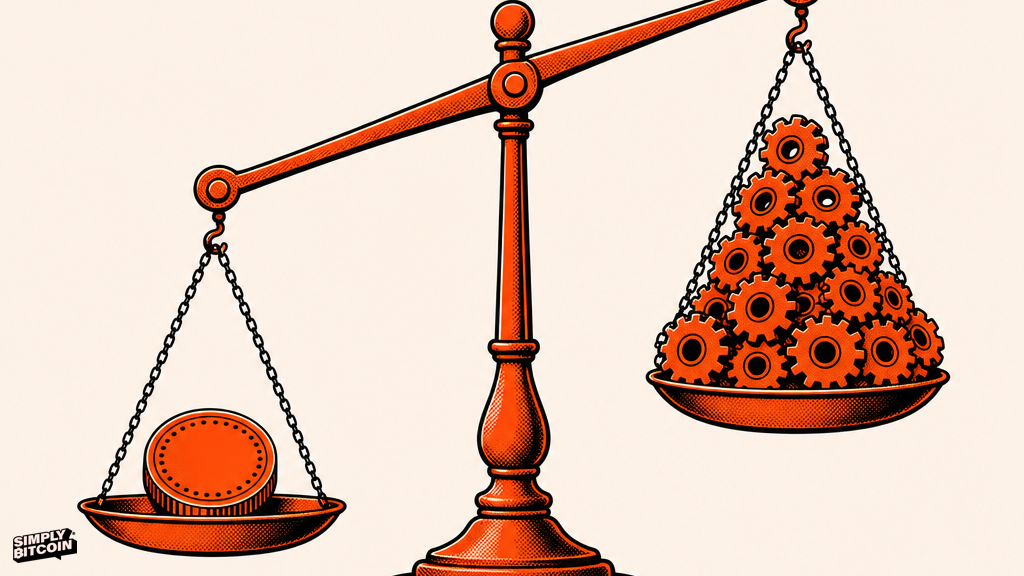
AI is about to run that same experiment on everything else humans make. Legal work, software, design, analysis: all of it becomes abundant, all of it gets cheaper, and the value that used to sit inside "this is hard to do" starts draining out. In a world like that, the assets that hold value aren't the ones doing the most. They're the ones that can't be made more of. That's the entire logic value investors have used for a century to find businesses with a durable moat. Bitcoin doesn't need a moat built out of complexity. It has one built out of a number that doesn't move.
OWN THE THING THAT CANNOT BE PRINTED
AI is going to make intelligence, labor, and software radically abundant, and abundance is deflationary by nature. At the exact same time, the monetary system that prices all of it is structurally inflationary, built to expand the money supply faster than the debt it's servicing. Those two forces are on a collision course, and something has to give.
What doesn't give is a supply cap. Twenty-one million was set before any of this started, and it doesn't renegotiate because a model got smarter. In a world where everything else is about to get radically easier to produce, the asset that refuses to be produced at all is the one worth owning.