
They Call It Growth. It's Financial Repression.

Bitcoin gained close to eight percent in a single session this week and roughly eighteen percent over three days. The internet did what it always does when the price moves hard: it went looking for a headline to blame.
Some pointed to a stray comment about a government Bitcoin position. Some pointed to the Clarity Act vote scheduled for September 15th. Some pointed to ETF inflows. All three explanations are being repeated with total confidence right now, and all three miss the mechanism actually doing the work.
THE EXPLANATIONS THAT DON'T ADD UP
Start with the vote. A Senate vote scheduled for September 15th has been public knowledge for months. Markets do not wait until the week of a telegraphed, calendared event to suddenly start pricing it in a single explosive session.
ETF flows are a symptom, not a cause. Money moves into Bitcoin funds because Bitcoin is already moving. Pointing at the inflow to explain the price is describing the wind by pointing at the leaves.
The rally coincided with the largest single-day wave of forced short covering in records going back to 2021, with traders who bet against Bitcoin getting run over and the cascade feeding itself. But a short squeeze needs a trigger. Something pushed price up first, hard enough to start liquidating the people betting against it, and that something came out of Washington, not out of crypto Twitter.
THE NUMBER THAT CROSSED THE SAME WEEK
The same week, the federal debt hit a record $40 trillion, according to the Treasury Department. The federal debt is now over 1.2 times the size of the entire American economy, and that ratio has only been reached once before, during the borrowing that funded World War Two. The federal government is projected to spend more than $1 trillion on net interest in 2026, more than it will spend on any mandatory program other than Social Security or Medicare.
Asked about it on live television, Treasury Secretary Scott Bessent had an answer ready: "there's nothing magic about the $40 trillion number, and we can grow our way out of that."
That sentence should have moved markets harder than anything else said that week. Not because it was wrong exactly, but because of what it was covering for.
GROWTH IS THE WORD. REPRESSION IS THE METHOD.
The day before Bessent said it, the Treasury announced the current maximum size of $2 billion per operation would become at least $4 billion per operation, doubling its buyback of long-dated government bonds starting September 9th.
The timing was not an accident. The 30-year Treasury yield had just surpassed 5.3 percent, its highest point in more than 19 years, and a government sitting on forty trillion dollars of debt cannot afford to refinance itself at those rates. So it did what heavily indebted governments have done before: it stepped in to hold its own borrowing costs down, funding the purchase with fresh short-term issuance.
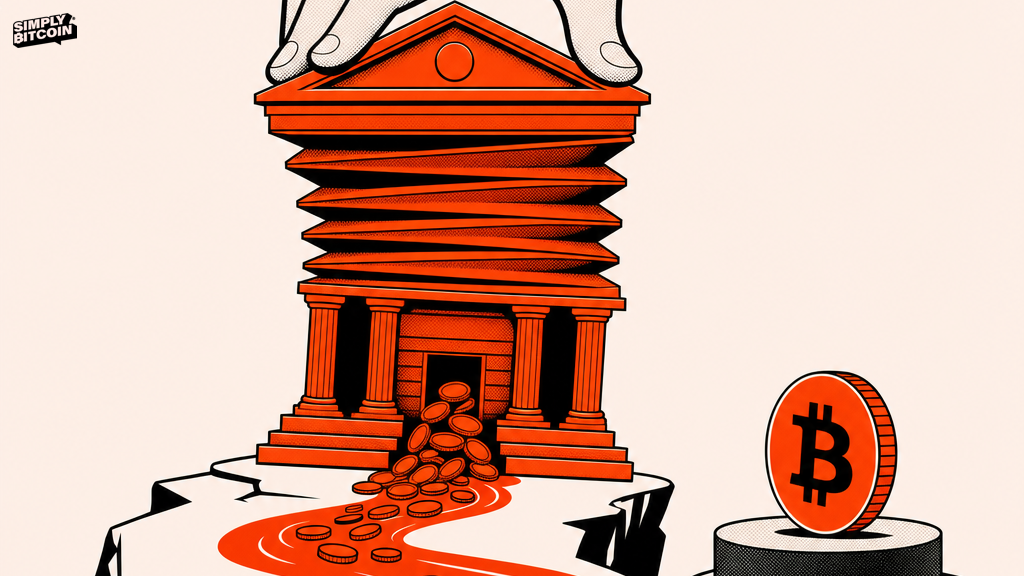
There is a name for that, and it is not growth. Growth is a rate of change in output. It takes years, and no announcement accelerates it on command. What happened that week was a decision, made in a room, about who buys the bonds and at what price. Economists have a term for a government suppressing its own borrowing costs by directing new money into its own debt: financial repression. Nobody at Treasury used that phrase. The phrase describes what a government does to its creditors, not what it does for its economy.
WHAT BITCOIN IS ACTUALLY PRICING
Bitcoin does not read press releases. It reads the arithmetic underneath them. Whichever agency does the buying, the Fed or the Treasury, someone has to create new demand for debt the market stopped wanting to hold at the rate offered. New demand paid for with newly issued liabilities is a polite way of saying more currency chasing the same goods.
That is why the short squeeze lined up with the buyback announcement and not with a vote everyone already knew was coming. Traders who were short Bitcoin were betting the debt problem could be managed quietly, off to the side, with language. The moment Treasury confirmed it was intervening directly in its own bond market, that bet stopped making sense, and the unwind did the rest.
Bitcoin has no board that can vote to buy back its own supply. Twenty-one million is the ceiling whether the buyback program ends in November or gets renewed again after that. Every unit created to hold a bond price steady still has to compete for the same fixed number of coins.

THE PART THAT DOESN'T NEED A PRESS RELEASE
Officials will keep finding new words for old mechanics. This cycle it is growth. Last cycle it had other names. The mechanics stay the same: when debt gets too large to refinance honestly, the state finds a way to buy its own paper and calls it something gentler.
Bitcoin does not need the right word for what is happening. It just needs the debt to keep needing buyers, and this week, that stopped being theoretical.