The Halving Is Policy

Sound money has always required institutions to resist the temptation to expand supply. Sometimes those institutions held. More often, they found reasons why this particular moment was the exception, why this crisis justified a temporary measure that became permanent, or why the old rules did not apply to new circumstances.
Bitcoin removes the temptation entirely. The schedule was written once, and it’s been followed every time since, and it will continue to be followed because the network that enforces it is made up of thousands of participants who each individually chose to run that code.
Changing the supply schedule would require convincing the overwhelming majority of those participants to voluntarily adopt a different version of Bitcoin, one that benefits issuers at the expense of holders. It has never happened. It will not happen. The incentive structure makes it nearly impossible, and the philosophical alignment of the people who run the network makes it unthinkable.
The halving doesn't require good leadership, nor does it require trust in officials. It just runs.
What The Halving Actually Is
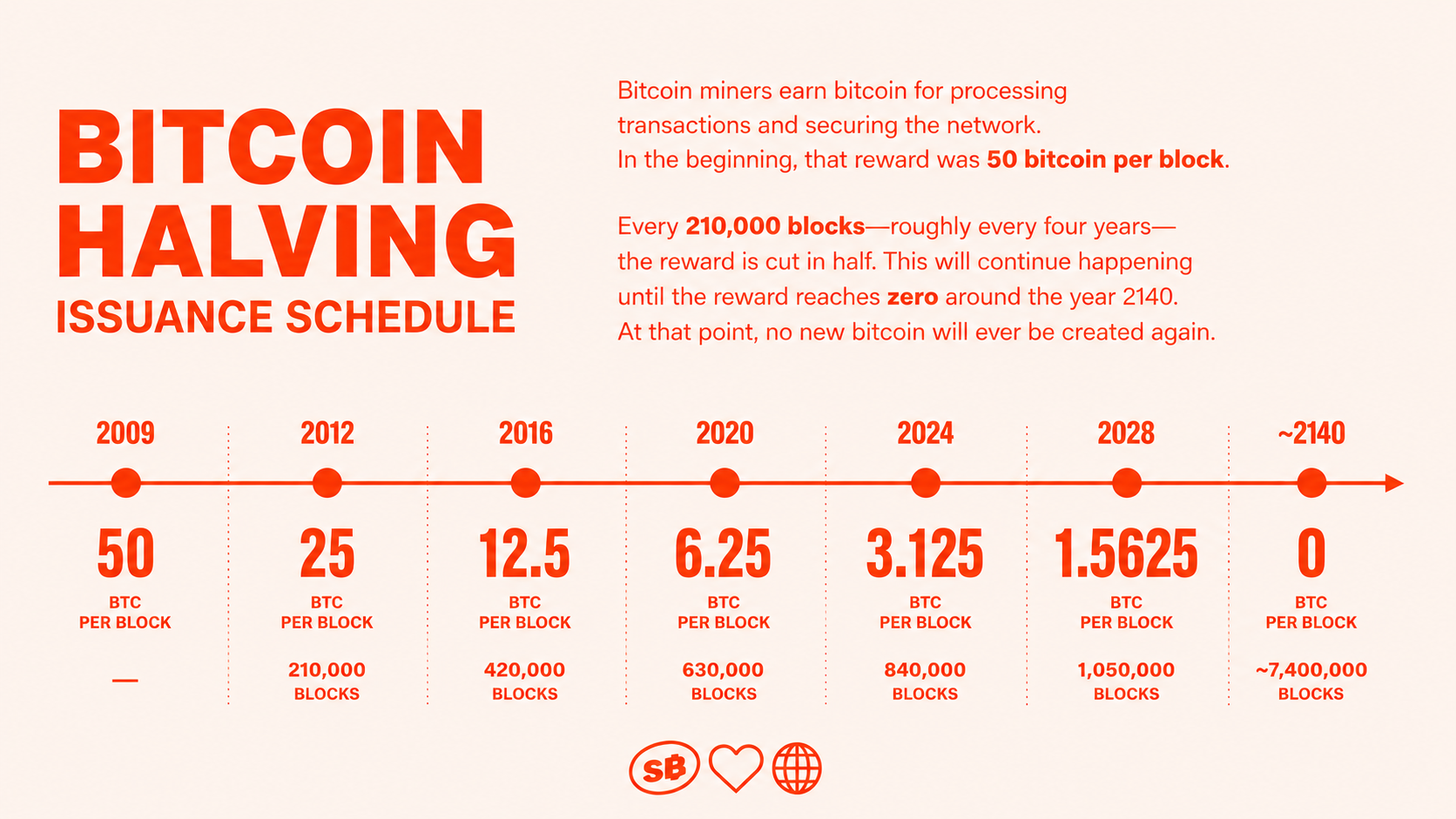
Bitcoin miners earn bitcoin for processing transactions and securing the network. In the beginning, that reward was 50 bitcoin per block. In 2012 it dropped to 25. In 2016 it dropped to 12.5. In 2020 it dropped to 6.25. In 2024 it dropped to 3.125. This will continue happening every 210,000 blocks, roughly every four years, until the reward reaches zero around the year 2140. At that point, no new bitcoin will ever be created again.
The total supply is hardcoded at 21 million. Every halving is a scheduled step toward that ceiling, enforced not by trust, not by institutions, not by regulators, but by math running on thousands of independent computers worldwide.
Every central bank in existence operates on the opposite model. Supply is discretionary. Policy adjusts to conditions. The money printer goes whenever the people holding the keys decide it should go. Governments borrow, deficits mount, the base is expanded. And every holder of that currency absorbs the cost of those decisions in the form of reduced purchasing power.
Bitcoin encoded a different answer, written into the protocol before the first block was ever mined.
The Discipline That Requires No Willpower

Sound money has always required institutions to resist the temptation to expand supply. Sometimes those institutions held. More often, they found reasons why this particular moment was the exception, why this crisis justified a temporary measure that became permanent, or why the old rules did not apply to new circumstances.
Bitcoin removes the temptation entirely. The schedule was written once, and it’s been followed every time since, and it will continue to be followed because the network that enforces it is made up of thousands of participants who each individually chose to run that code.
Changing the supply schedule would require convincing the overwhelming majority of those participants to voluntarily adopt a different version of Bitcoin, one that benefits issuers at the expense of holders. It has never happened. It will not happen. The incentive structure makes it nearly impossible, and the philosophical alignment of the people who run the network makes it unthinkable.
The halving doesn't require good leadership, nor does it require trust in officials. It just runs.
What This Means For Everyone Who Holds
If you hold bitcoin, the halving is not something that happens to you. It is something that works for you. It is the enforcement mechanism for the promise that was made when you acquired that first satoshi: the supply is fixed, the rules will not change, and no actor can dilute your stake without your consent.
Every halving that passes without incident is proof of concept. It is the network demonstrating, once again, that the schedule holds, that the math works, that the rules apply equally whether the price is up or down, whether the political climate is friendly or hostile, whether powerful interests want it to happen or not.
The halving happens on schedule whether a president is pro-Bitcoin or anti-Bitcoin, whether regulators are paying attention or not, whether the mainstream narrative is bullish or bearish. The code runs, the subsidy drops, and the supply curve bends.
No other asset in the world can make that statement. Gold's supply is variable, controlled by whatever ore exists and whoever chooses to mine it. Fiat currencies expand whenever the issuer decides they should. Every other "store of value" is subject to the preferences and incentives of whoever controls its creation. Bitcoin is not.
The halving is the mechanism that makes all of this real. A scheduled, verifiable, unstoppable enforcement of the rules that everyone agreed to when they joined the network.
The Policy No Politician Can Reverse

Central banks issue forward guidance. They announce intentions to raise or lower rates, to expand or contract the balance sheet, to support or remove accommodation. Markets hang on every word because the word can change. The policy is only as reliable as the humans setting it, and humans respond to pressure, incentives, and political survival.
Bitcoin issued its forward guidance in 2009 and it has never changed. The halving schedule is public, it is permanent, and it has been running without deviation for over 17 years. Every four years the market gets to watch it happen again, and every time it happens it confirms the same thing: this is a monetary system that keeps its promises.
That is not just a technical feature. That is the foundation of sound money. Scarcity that is real because it’s enforced, not because someone says so.
The halving is policy. The best kind: the kind that can’t be changed.