The Chart Panics. The Standing Order Doesn't.
In November 2026, Bitcoin's price cracked below $60,000 and briefly touched $55,000 in a single session, roughly half its October high. Seven straight weeks of red came before it, a losing streak the market had only produced a handful of times since 2014. Every one of those stretches arrived with the same verdict: Bitcoin is finished.
The instinct in that moment is to do something. Sell before it falls further. Wait for a cleaner signal. Buy more because the chart looks like a bottom. All three responses share the same hidden assumption, that the right move depends on a decision made right now, under maximum pressure, with the least information anyone involved will ever have.
THE DECISION THAT ACTUALLY MATTERED WASN'T MADE THIS WEEK
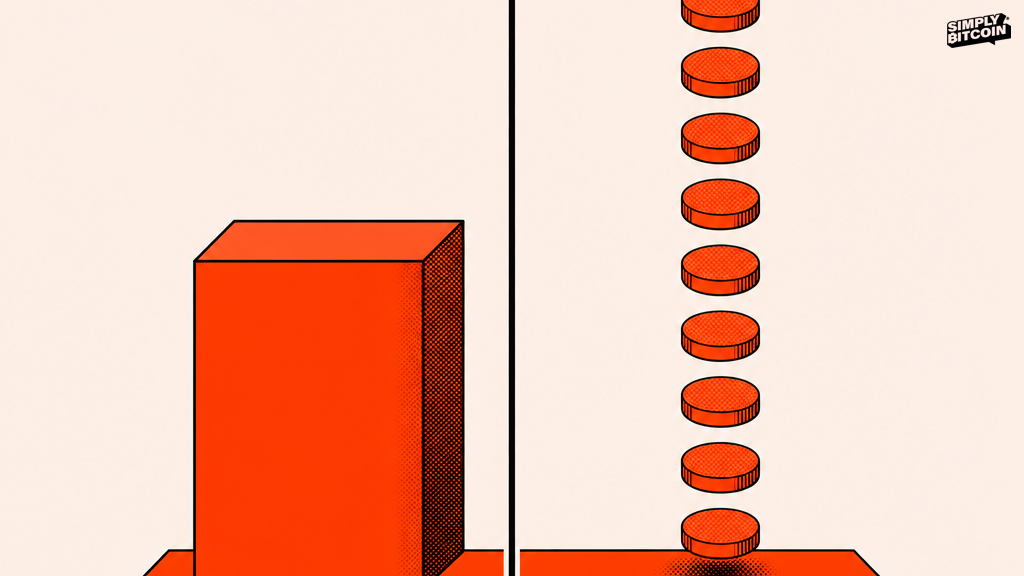
Run the numbers on two buyers starting from the same date, March 31, 2021. Bitcoin traded at roughly $58,500 that day. Measured against that same price years later, a buyer who put the whole amount in at once and held through every crash in between ended up back near where they started, flat.
A second buyer committed to buying a fixed, small amount every single day, no matter what the chart was doing. That buyer finished up 36 percent over the same stretch, through the same crashes, the same seven week losing streaks, the same headlines calling the asset dead.
Same asset. Same volatility. Same crash to $55,000. The difference was not timing skill. The second buyer had already made the decision, once, in a calm moment, and then never had to make it again.
WHY REMOVING THE CHOICE BEATS MAKING IT
This feels backwards. More control should produce a better outcome than less. But the moment a discretionary decision actually has to be made is never a neutral moment. It is the exact moment fear or greed is at its highest, because that is what makes a chart move sharply enough to force a decision in the first place.
A lump sum buyer who held through the crash to $55,000 still had to sit through every day of the decline wondering whether to sell. A buyer on autopilot had already removed that question from the table before the crash happened. The second person did not out-predict the market. They simply never gave the moment of maximum fear a vote.
BITCOIN MADE THE SAME TRADE AT THE PROTOCOL LEVEL
Bitcoin's issuance schedule works on an identical principle, just applied to money instead of to a buying habit. There are 21 million coins, issued on a fixed curve that was set once and has never been revisited. No committee reviews it during a crisis. No vote gets called when a crash makes the decision feel urgent.
A central bank's mandate is reviewed constantly, by design, which means every crisis becomes an opportunity to revisit the number. Bitcoin's supply was never built to be revisited. The discipline was front loaded into the code once, the same way the DCA buyer front loaded their discipline into a standing order, so that no future panic ever gets a seat at the table.
THE ONLY PART OF THE SYSTEM STILL RUNNING ON DISCRETION IS YOU
This is the part that is easy to miss while admiring the protocol's discipline from a distance. The supply schedule cannot be talked into changing its mind. Your finger on the sell button can. The weak point in the entire system was never the 21 million. It was always the human sitting on top of it, deciding in real time whether to keep the plan or abandon it the moment the plan gets uncomfortable.
That is not a character flaw. It is a structural one, and it applies to everyone, including people who genuinely understand why the supply is fixed. Knowing the math does not immunize anyone from the feeling of watching a position cut in half in a single session.
THE STANDING ORDER DOESN'T FLINCH
A pre-committed, automatic buy is the personal version of what the protocol already does at the monetary level. It takes the one decision that would otherwise get made at the worst possible time and relocates it to a calm afternoon, long before any crash, where fear has no leverage over it.
The $55,000 print did not need a hero who correctly called the bottom. It needed a standing order that had already been placed and simply kept executing while everyone else argued about whether the asset was dead. That order did not know the price was down. It was not built to know. That is the entire point.


Daily Bitcoin news, analysis and interviews. New shows every single day.
Subscribe on YouTube