
A Shutdown Freezes The Bank. It Can't Freeze The Network.
A government does not need to find your bank account to stop you from paying for dinner. It only needs to turn off the wire your bank account runs on. Cutting the connection rather than freezing the account is becoming one of the most common tools of state control anywhere protests happen, and most of the money people use every day has no answer for it.
THE NEWEST OFF SWITCH
In 2025, the #KeepItOn coalition counted 313 government ordered internet shutdowns across 52 countries. That is the highest total on record, ahead of 304 in 2024 and 289 in 2023. Dozens of those shutdowns were still running when the year ended, carried straight into the next one.
These are not rare, dramatic events confined to one regime. They happen during protests, elections, exams, and unrest, in Myanmar, India, Pakistan, Kenya, and a growing list of places that had never done it before. The tool is spreading because it works, and it works precisely because it does not require a government to identify a single account, a single person, or a single transaction. It only requires a switch.
WHY YOUR MONEY DIES WITH THE CONNECTION
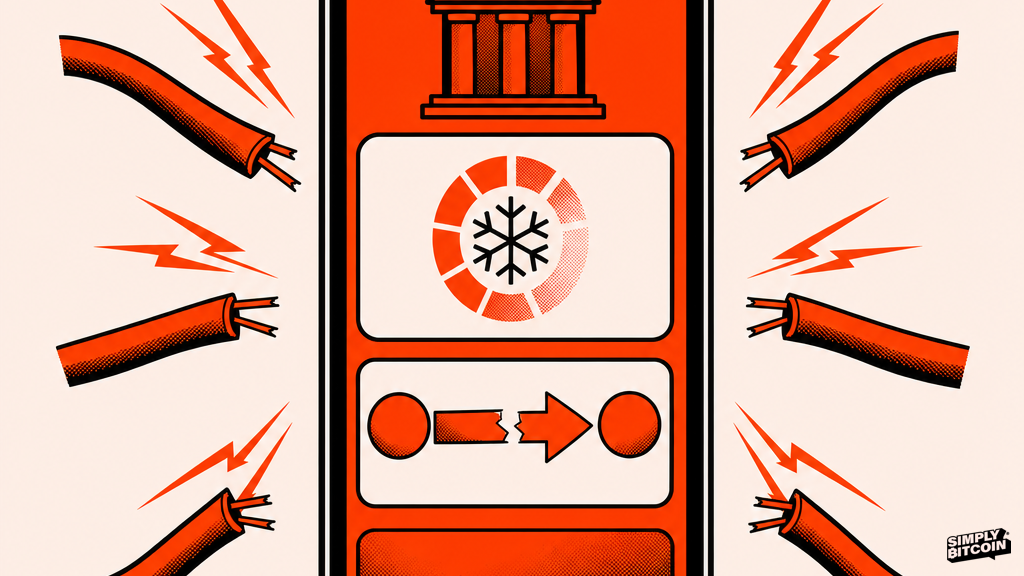
A bank balance is a number on someone else's server. A card swipe is a request that has to reach that server and get a yes back before the transaction clears. A mobile payment app is the same request wearing a nicer interface. All of it depends on a live connection to a centralized system, and all of it goes dark the moment that connection does.
This is true even when nobody has frozen anything and nobody is even a target. The shutdown does not discriminate. It takes down the protester, the bystander, and the small business owner trying to sell bread at the same time, because the chokepoint is the wire itself, not any individual's standing with the state.
A SIGNATURE DOESN'T NEED THE INTERNET
Bitcoin was not designed around the internet as we know it. It was designed around a signed message that proves ownership and a network of participants who can verify that signature and agree on an order. The internet is simply the most convenient way to move that message today. It is not the only way.
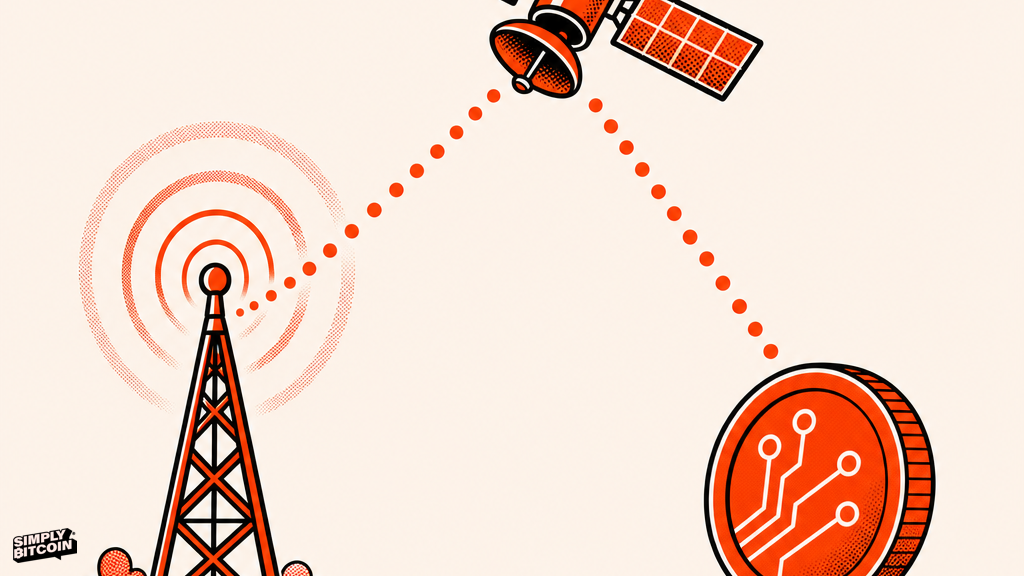
In 2019, a developer sent a bitcoin transaction from Toronto to Michigan using a ham radio, bouncing the signal off the ionosphere. No cell tower, no cable, no satellite, just radio waves carrying a signed transaction until it reached a node that could relay it. It was clumsy and slow, and it proved the point anyway: the protocol does not care what carries its packets.
Since then the clumsy proof has become working infrastructure. Blockstream Satellite broadcasts the Bitcoin blockchain continuously from space, so a node with a small dish can stay synced without touching a telecom network at all. Mesh devices like goTenna relay signed transactions phone to phone until one of them finds an exit point to the internet. Locha Mesh, built by Bitcoin Venezuela, runs long range radio nodes that have carried transactions across multiple hops in places where both cellular and fiber were down. None of it needs a government's permission to keep functioning, because none of it depends on a single piece of infrastructure a government can order switched off.
THE LEVER THAT STOPS WORKING
Here is the part that should unsettle anyone who thinks the shutdown is a winning move. The more a government reaches for this lever, the more people route around the exact system that lever depends on. A tool that only works once discovers its limit the second time, and a shutdown that fails to stop money from moving is a shutdown that cost a country its economy for nothing.
The lever still works perfectly on a bank. It still works on a card network. It still works on a custodial app that needs a live connection to someone else's server before it will let you touch your own funds. It simply does not work on a settlement system that was built to treat the internet as one option among several.
WHAT SURVIVES THE SHUTDOWN
None of this means Bitcoin floats free of all infrastructure. A signed transaction still needs some path to a node, and radio, satellite, and mesh links are slower and clumsier than fiber. Bitcoin does not solve every hard moment a shutdown creates. What it solves is narrower and more important: it removes the single point of failure that makes a shutdown total.
A government can turn off the wire. It cannot turn off every wire, every frequency, and every relay at once, and the moment one path stays open, a signed transaction can travel it. That asymmetry is the whole argument. The bank needs the connection to exist. Bitcoin only needs one to survive.